Ordering custom disc golf discs is a different exercise from ordering a promotional flying disc for a company picnic. A disc golf disc is a piece of sports equipment, and the people who catch one at your event or buy one from your pro shop will judge it by how it flies, how it feels in the hand, and how long the print survives a season in the bag. Before you approve a proof, you are really making four decisions: which mold to print, which plastic blend to use, what weight to specify, and how your artwork gets onto the disc. Getting each one right is the difference between a disc that gets thrown and one that ends up as a wall decoration.
Start with the mold, not the artwork
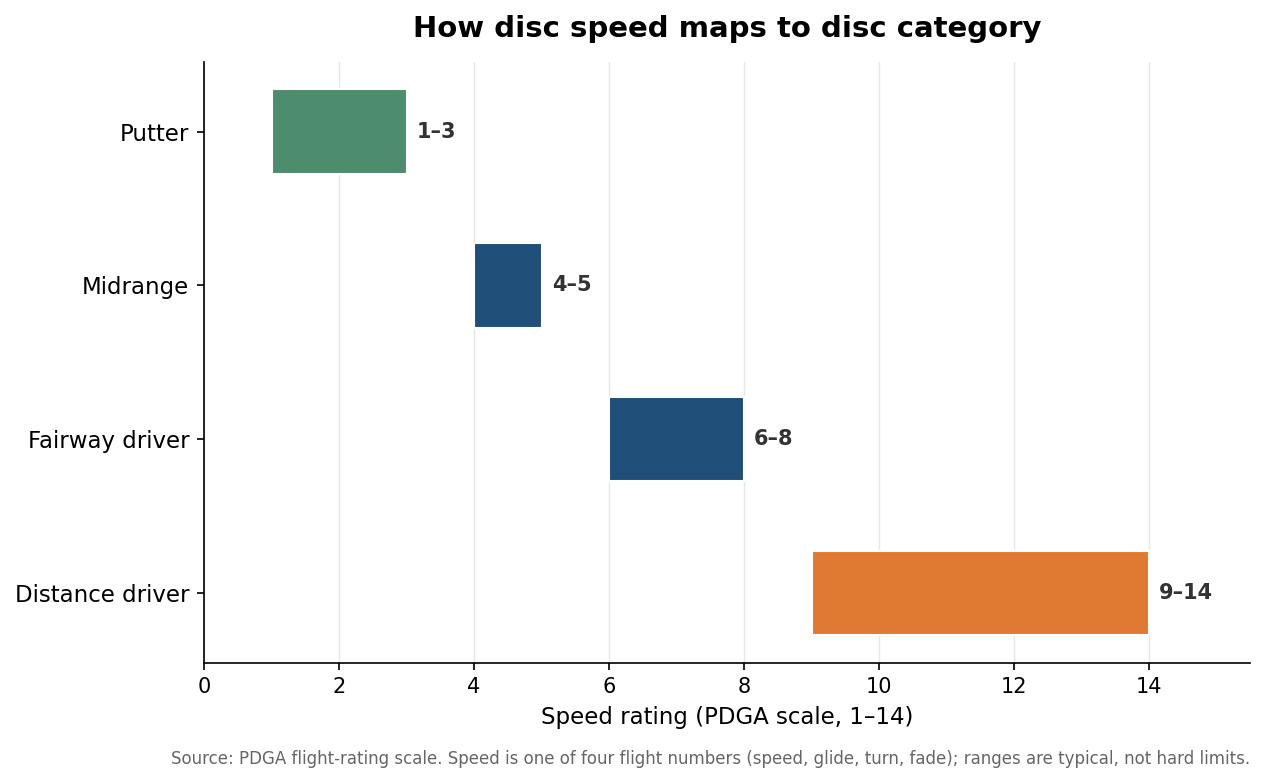
Every disc golf mold carries four flight numbers, and they matter more than any design choice you will make. Speed runs from 1 to 14 and describes how fast the disc has to travel to fly as intended. Glide runs from 1 to 7 and measures how long the disc stays aloft. Turn runs from roughly +1 down to -5 and describes how much the disc banks right early in flight for a right-handed backhand thrower. Fade runs from 0 to 5 and describes how hard it hooks left at the end. A putter reads something like 2, 3, -1, 1; a fast distance driver might read 12, 5, -1, 3.
The practical point is to match the mold to whoever ends up throwing it. High-speed drivers only fly correctly for players with real arm speed, and in a beginner’s hand they dump left almost immediately. If your discs are a tournament giveaway, a league fundraiser, or a brand promotion aimed at a general crowd, a low-speed putter or midrange in the speed 2 to 5 range is far more forgiving and will actually get used. Save the speed 12 drivers for an audience of players who asked for them.
Match the plastic to the budget and the use
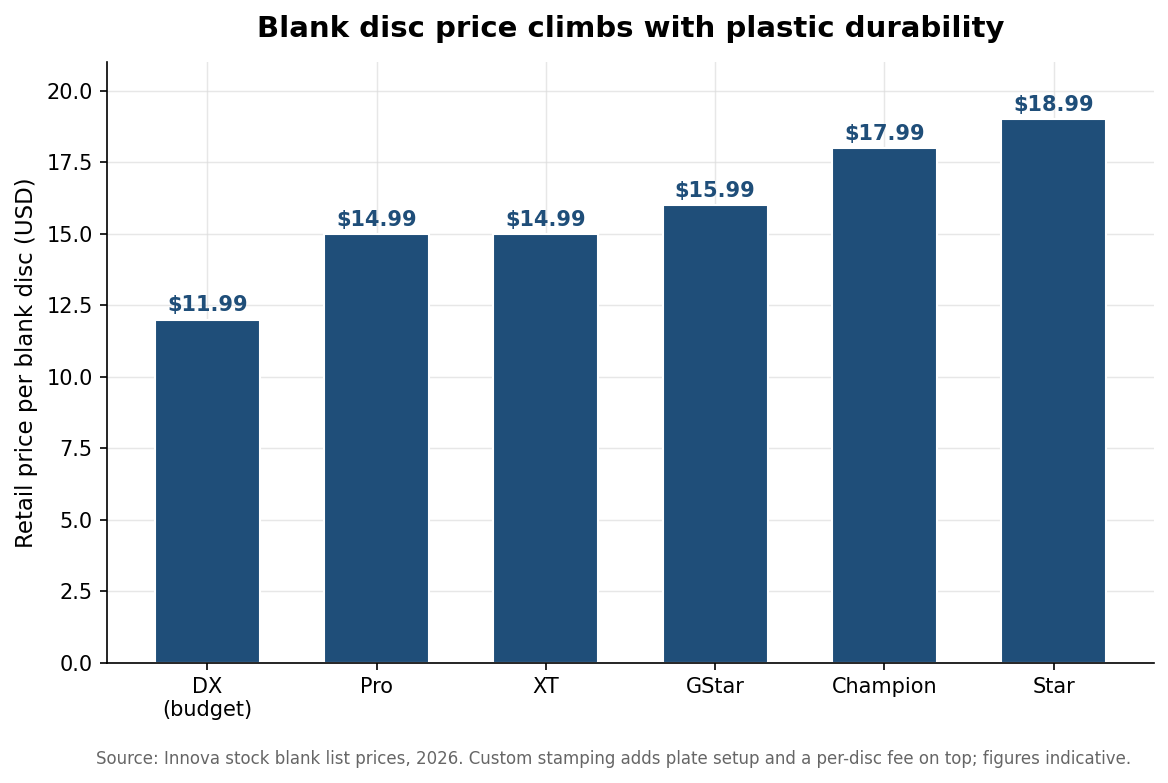
Plastic blend sets both the feel and the price, and the gap is wide. Base plastics such as Innova’s DX list around twelve dollars a blank; they are grippy and cheap but wear quickly, which for a giveaway is often fine. Mid-grade blends such as Pro and XT sit near fifteen dollars and hold up better. Premium blends such as Champion and Star run eighteen to nineteen dollars a blank, resist trees and pavement, and keep their flight characteristics far longer. Those are stock blank prices, and custom stamping adds plate setup and a per-disc fee on top, so treat them as a floor rather than a final number.
The blend you choose should follow the job. For a five-hundred-disc promotional run where cost per unit is the whole ballgame, base plastic keeps the total sane and nobody minds that a free disc wears in. For a players’ pack, a resale run in a shop, or a club’s tournament stock, premium plastic is worth the premium because the buyer expects a disc that survives the season and the print that survives with it.
Get the weight right
Most disc golf discs are produced somewhere between about 150 and 176 grams, and the number is stamped or written on nearly every disc for a reason. The PDGA caps maximum weight relative to diameter, working out to roughly 8.3 grams per centimeter, or about 175 grams for a standard driver, so you will rarely see a legal disc heavier than that. Within the usable range, lighter discs in the 150 to 165 gram band are easier for beginners, younger throwers, and anyone with lower arm speed to get moving, and they float better on water. Heavier discs in the 170 to 176 gram band hold a line better in wind and resist getting turned over by a strong arm.
If you are buying for a known audience of players, ask what they throw. If you are buying for a mixed or unknown crowd, a middle weight around 165 to 172 grams is the safe compromise that most hands can handle. These bands are indicative rather than rules; a specific mold in a specific plastic will feel slightly different, and a run-to-run weight tolerance of a few grams is normal in manufacturing.
Specify the stamp before you approve the art
Most custom discs are decorated by hot stamping, where a heated die presses colored foil onto the flight plate. It is durable, it is the industry standard, and it is what drives your setup cost. Each foil color generally needs its own stamp plate, and plate setup commonly runs around one hundred dollars per color, so a single-foil design starts near one hundred dollars in setup while a three-foil design can carry three hundred dollars in startup charges before a single disc is stamped. Minimum orders for hot-stamped customs typically begin around one hundred discs, which is why the first disc is expensive and the hundredth is cheap.
Design details matter to the die. A two-color foil job needs at least a 1/16-inch gap between the colors so they do not bleed together, oversized stamps can add a per-disc stamping fee on the order of two dollars plus a larger die charge, and artwork should be supplied as clean vector or at 300 ppi at print size, usually in grayscale, sized to the roughly 5.25-inch print area on a standard disc. If you need full-color or photographic artwork rather than flat foil, dye sublimation processes such as DyeMax handle that, and one-off artistic dyes exist for short runs, though neither is the tool for a large economical order.
Put the four decisions together before you pay for anything. Lock the mold and its flight numbers to your audience, choose a plastic blend that fits the budget and the expected use, pick a weight band, and settle the stamp method and foil count. Then confirm your artwork format and the lead time, which often runs a few weeks once a plate is cut. Because setup fees are fixed and per-disc costs fall with volume, the cheapest path is almost always to decide everything once and order the whole quantity in a single run rather than reordering a plate you have already paid to create.
Leave a Reply