Two custom discs can look identical in a mockup and behave nothing alike in the air. One sails flat across a parking lot at a company picnic; the other flutters, dives, and lands ten feet short. The difference is almost never the print. It is a handful of physical specifications that most promotional buyers never see on a product page: weight, diameter, rim geometry, and the plastic itself. Understanding how those four levers work lets you order a disc that actually flies for the people who will throw it, instead of one that only photographs well.
Weight is the single biggest lever
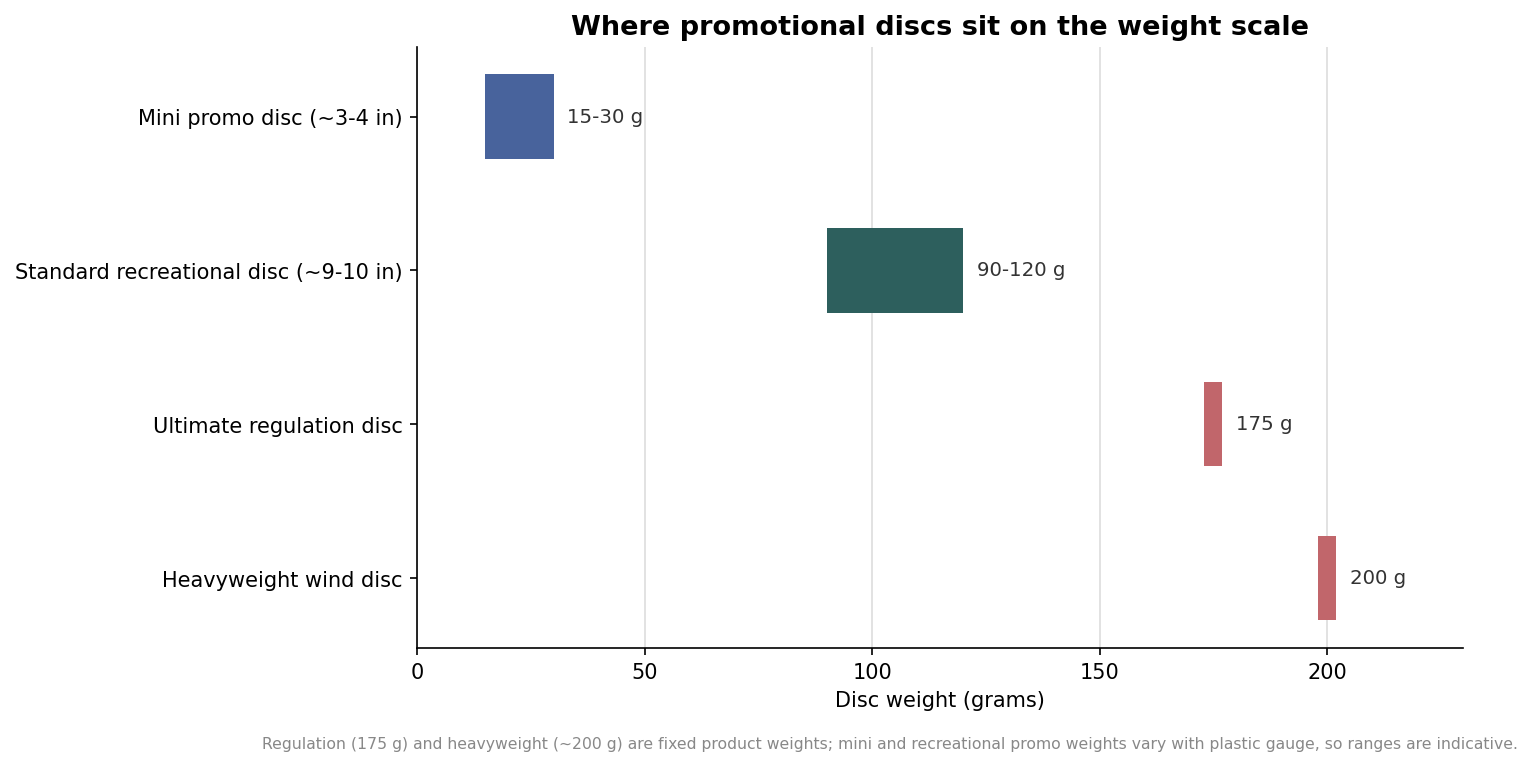
Weight decides how a disc fights the wind and how much effort it takes to throw. The widely used Ultimate regulation weight is 175 grams, heavy enough to hold a line in a breeze and the reason competition discs feel so stable. Recreational and promotional discs usually come in lighter, often somewhere in the region of 90 to 120 grams for a standard nine- to ten-inch disc, which makes them easier for casual throwers and children to launch but more prone to drifting on a gusty day. At the extremes you will find featherweight mini discs of only a couple of dozen grams, and specialty heavyweight discs around 200 grams built specifically to punch through wind. None of these is objectively better; the right weight depends entirely on who is throwing and where. The chart below shows how the common categories stack up.
Diameter and the recreational-versus-regulation gap
Diameter sets the aerodynamic surface and, along with weight, how the disc feels in the hand. A regulation Ultimate disc runs about 27 centimeters, roughly 10.75 inches, across. Standard promotional discs cluster a little smaller, commonly in the eight- to ten-inch range, with mini discs down around three to four inches used more as novelties and keepsakes than as real throwing tools. Bigger is not automatically better here. A larger disc presents more surface for lift but also more surface for the wind to grab, and a nine-inch disc in a lighter gauge is often the sweet spot for a giveaway that has to work for a wide range of ages and arm strengths. If the disc is meant to be genuinely thrown rather than pinned to a memo board, stay close to the recreational nine- to ten-inch band and let weight do the fine-tuning.
The rim does the aerodynamic work
The flat top gets the print, but the rim is what makes a disc a disc. Most of the mass sits in that rolled edge, and concentrating weight at the perimeter is what gives a spinning disc its gyroscopic stability, the stubborn tendency to keep its orientation once it leaves your hand. A deeper, heavier rim resists wobble and tracks straighter, which is why serious flying discs feel weighted toward the outside rather than the center. A shallow, thin rim on a cheap disc spins down faster and starts to tumble sooner, and no amount of throwing technique fully compensates. The way the mold distributes plastic between the flat flight plate and the rim is effectively invisible in a photo, yet it is the difference between a disc that glides and one that stalls. When you compare quotes, a disc that specifies a defined rim depth and edge weight is telling you it was engineered to fly, while one that only lists overall diameter and a print area may not have been. If a sample is available before a large run, spin one hard on a flat surface: a well-balanced disc settles into a long, steady spin, and a poorly molded one lurches off to one side almost immediately.
Plastic choice changes flight, feel, and durability
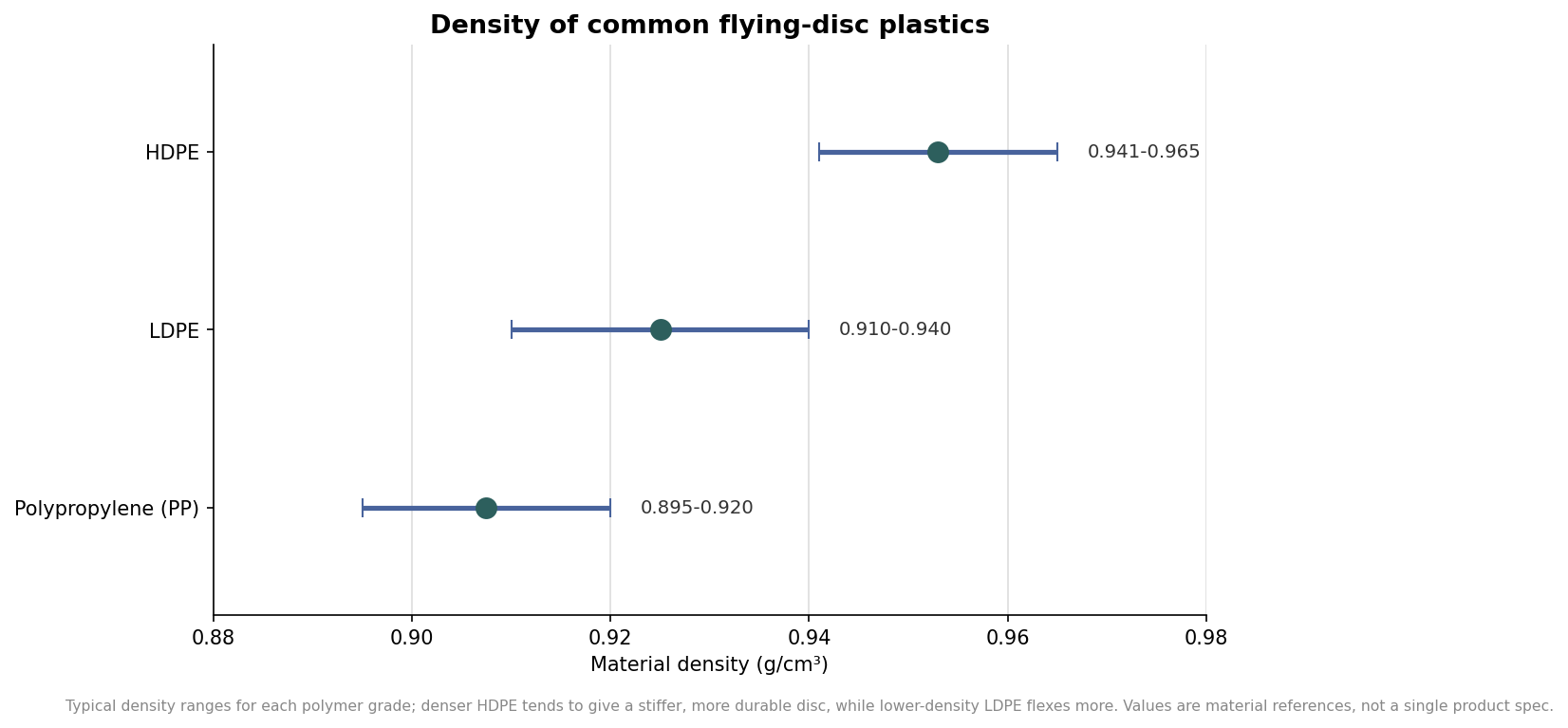
The polymer is where flight performance and print quality meet cost. Flying discs are typically molded from polyethylene or polypropylene, and the grade matters. LDPE, low-density polyethylene, is the flexible option: its branched molecular structure makes it soft and forgiving, so the disc bends rather than cracks and feels friendly in a child’s hand. HDPE is the rigid, durable end, with a denser, more linear structure, better impact and UV resistance, and a stiffer flight that holds its shape in wind. Polypropylene sits nearby as a light, resilient middle path. The density differences are small in absolute terms but consistent, and they track directly to how stiff the finished disc feels. The dot plot below shows the typical ranges. For decoration, stiffer surfaces tend to hold a crisp pad print or screen print well, while very flexible material can demand inks formulated to flex with the disc so the artwork does not crack over time. Durability matters beyond the print, too: a disc handed out at an outdoor event will live in sun, gravel, and car trunks, and the HDPE end of the range shrugs off that abuse far better than a soft LDPE disc that scuffs and creases. The trade-off is feel, since the stiffest discs are also the ones most likely to sting a young catcher’s hands, which is exactly why matching the plastic to the audience matters as much as matching the weight.
Put the four levers together and the specification almost writes itself. For a children’s event, lean light and flexible: a lower-weight LDPE disc in the nine-inch range that is easy to throw and safe to catch. For a sports team or an adult league giveaway, move toward regulation weight and a stiffer plastic so the disc actually performs the way athletes expect. For a pure marketing keepsake that will spend its life on a desk, a mini disc is cheaper and does the job. Ask any supplier for weight, diameter, rim depth, and resin type before you commit, and treat the weight and diameter figures here as starting points to confirm against the specific disc you are quoting. Get those four numbers right and the print, which is the part everyone worries about first, becomes the easy part.
Leave a Reply